what is a chemical reaction used to show
The focus ideas of pushes and pulls is explored through
- Contrasting educatee and scientific views
- Critical didactics ideas
- Teaching activities
- Farther resources
Contrasting pupil and scientific views
Student everyday experiences
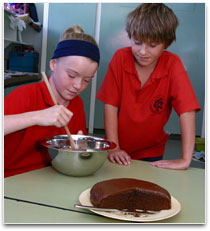 Children will take experienced many examples of chemic change without actually realising it. They are familiar with burning, cooking, rusting and chemic processes that appear to involve dissolving. Still at this level students don't run into new materials beingness produced as a effect of chemical alter, rather they see that existing materials have only been modified in some way. For instance they meet smoke as part of the wood that is somehow released when the wood burns. Because students rarely understand the concept of 'a substance' they don't see substances being changed. Nonetheless an understanding of chemic alter is primal to affectionate the part of chemistry in their lives and at this level students tin can begin to capeesh this.
Students frequently believe that to get something new, things just need to be mixed together. When a chemical reaction does take place, they believe that one or other of the reactants is just modified; it hasn't really inverse. For example, students consider that rust is even so iron/steel; it has just gone brown. Similarly, rust flaking off is usually not noticed – it is thought that the iron simply disappears. Gas bubbles that are oftentimes produced when a tablet dissolves in h2o are ofttimes not seen by students as a new substance. Processes like cordial mixing with water, the use of colouring in food, freezing and humid are seen as similar to chemic changes like those involved in cooking eggs.
Research: Johnson (2002)
In combustion, children frequently believe materials like wood or newspaper only disappear - later on all there is not much of the product left to see. In their view, air has trivial to do with burning. In burning carbon based materials such as wood, students believe that charcoal (carbon) appears from the burning rather than the textile.
Research: Arizona Statdue east University (2001)
Because so many reactions children know about are involved in things similar cooking and burning, they presume that oestrus is always necessary for reactions to occur.
In everyday language, the word 'chemical' is frequently used as a label for undesirable things that shouldn't be in foods or cosmetics. Hence students may regard chemicals as a group of substances found in laboratories rather than seeing all the substances in foods (for example) equally chemicals.
Scientific view
All materials are made of chemicals. Chemic reactions involve interaction between chemicals such that all reactants are changed into new materials. The backdrop of the new materials are unlike from those of the reactants. This is singled-out from other changes such as evaporation, melting, humid, freezing and mixing where changes involve no new substances. While heat is often necessary to start reactions, this need not be the instance.
Chemical reactions involve breaking chemic bonds between reactant molecules (particles) and forming new bonds between atoms in product particles (molecules). The number of atoms before and after the chemical alter is the same simply the number of molecules will change.
Although many chemical reactions proceed quickly, small-scale, slow changes such as rusting or biological processes can take place over much longer periods of time.
Chemical reactions are reversible (a fact oft omitted in many science texts) but in exercise most differ from other changes children find, such every bit melting, by being very difficult to reverse.
Humans use chemical reactions to produce a wide range of useful materials; the breakdown of waste material materials as well involves chemical reactions that occur naturally in the environment. For some human fabricated wastes, there are no such reactions and they cause problems every bit a upshot.
Critical instruction ideas
In teaching about chemical reactions at this level the emphasis should exist on improving educatee agreement of the importance of chemical reactions in our lives in producing many of the things we take for granted equally well as improving their recognition and understanding of what is involved in a chemical alter. Information technology is non necessary at this phase to talk about particles such as atoms or molecules or chemical bonds.
- Chemical reactions involve the production of new materials which are quite different from the reacting substances. Any new materials come from the reacting substances.
- Changes that may accompany a chemic reaction include colour, advent and product of new materials, for example, a gas.
- Mixing lonely may not cause a chemical reaction to take place.
- While heat is often necessary to initiate a chemical reaction it is not always necessary.
- Chemic reactions are used to produce virtually of our energy.
- Chemical reactions are used extensively to test, identify and analyse a wide range of materials (for case, pool testing kits and forensic tests from tv set shows such as 'CSI').
- The oxygen in air is a very reactive chemical and is important in many chemic reactions such as combustion, rusting and the reactions by which nosotros get energy from the nutrient we eat.
 Explore the relationships betwixt ideas about chemic reactions in the Concept Development Maps – (Atoms & Molecules, Chemic Reactions, Conservation of Matter, States of Matter)
In learning near chemical reactions students will need to depict various substances, which at this level will be materials they are familiar with (the kitchen and changes involving cooking are very practiced starting points). They will need to be able to place changes in these substances with the purpose of eventually recognising when new chemicals have been produced i.due east. a chemical change has taken identify. Equally mentioned to a higher place, this is can be difficult as students often neglect to see the difference between an egg white going through a alter from liquid to solid as information technology is cooked and changes such equally melting chocolate or boiling water which do not involve chemical change. Educational activity will need to be focused on what happens when new substances are formed.
These ideas are also explored in the focus idea Bug with classifying.
Environmental effects of chemic reactions can also exist considered, for instance how we dispose of some chemicals one time they are produced, in forms such equally plastic bags.
Open up word via a shared experience
Initial teaching activities should aim to bring out students' existing ideas. At this stage information technology is important that students are encouraged to put up their ideas and discuss them in modest groups. All alternatives should be considered with no resolution at this stage.
A starting activeness could exist observing the called-for of a candle and discussing the changes that have identify. Hither the distinction tin can be made between the melting of the wax and the appearance of new materials. Questions posed could include:
- what happens to the wax?
- what is burning?
- where do you recall the wax is going?
- could yous collect it over again?
- is this the same procedure equally water evaporating?
- would the candle burn if there was no air around information technology?
- is air or part of the air used up when a candle burns?
Promote reflection on and description of existing ideas
Activities which provide issues to be explored and challenge existing ideas are useful in encouraging students to seek new explanations for things they observe. Students should investigate a number of changes and ask questions similar to those above. In all of these students should be encouraged to detect the changes that take place and to identify what products are formed. Discussion tin besides eye on how these are dissimilar from the starting materials. Some examples could include:
- Baking soda and vinegar in a corked glass canteen - why does the cork wing off?
- Add bicarbonate of soda to a glass containing vinegar and six currants. Why do the currants move up and downwards? What are the bubbling? Where are the bubbling coming from?
- Making sherbet – mix 4 parts icing carbohydrate, 2 parts citric acid and one part baking soda (these are all available from supermarkets). Students put a minor amount of the mixture on their tongue. What causes the buzz? Do any of the powders on their ain produce a buzz?
- Half fill up a jar with steel wool (without soap) and add enough vinegar to encompass the steel wool. Leave for five days. Pour one tablespoon of the resulting liquid into a 2nd jar. Add one teaspoon of household ammonia and stir. A nighttime light-green glutinous textile will form. Once more, students should be asked to consider what is happening - the accent being on developing an agreement that new materials are being produced.
- Making caramel - students are asked to investigate sugar. Warm a full-bodied sugar solution, observing the changes along the mode - sugar dissolving, and then browning. Caramelising involves a series of chemic changes. (In that location are many caramel recipes - butter, blistering soda and table salt can all be added to meliorate taste, advent and texture). Students should be encouraged to look for prove of chemical changes as opposed to melting.
Practise using and build the perceived usefulness of a scientific model or idea
Other activities tin involve chocolate making. Students tin be encouraged to look for the differences between making chocolate where the chocolate melts and the production of caramel/toffee where the sugar changes into something different.
At that place are many other similar chemical changes that can be investigated - farther cooking activities can include: making a chocolate cake, melting and browning cheese, making honeycomb, baking bread, poaching eggs and making toast. Other changes can include the setting of 2 component glues like Araldite and mixing steel wool and a solution of copper sulfate (available from plant nurseries). Oxygen is a very important reactant in many chemic reactions and students tin can investigate changes involving this component of air.
Analyze and consolidate ideas for/by advice to others
It is important at this stage to clarify and consolidate what students have observed and to focus on what happens in a chemical reaction which is different from melting, boiling and freezing. To achieve this students could exist asked in groups to make mini posters which prove the changes that take place in the i or more of the reactions they accept seen, peculiarly comparing the products with the starting materials and demonstrating how they are unlike. This tin can be assisted by using new names for the products, such as 'soot' or 'carbon dioxide'. Students then present their posters to the class.
Resulting class discussion should bring out student ideas, examine alternatives and move to more accustomed scientific views about chemical reactions.
Activities should be carried out which test the usefulness of the chemic reactions model and farther consolidate student ideas about what constitutes a chemical reaction. Students tin be further encouraged to compare the products with the starting materials. For instance students could investigate the rusting of a steel nail under different weather condition (such equally in air/water/salty h2o).
To further develop students' appreciation of the role of chemical change in their lives, they could research the production of metals from ores (such every bit aluminium and steel) or the production of plastics and synthetic fibres. The emphasis in this exploration is on the importance of chemical change in producing the materials we utilize every day.
Further resources
Science related interactive learning objects can be found on the FUSE Teacher Resource page.
To access the interactive learning object below, teachers must login to FUSE and search past Learning Resource ID:
- Mystery Substances: your first case – students solve police cases by identifying pure substances and components of mixtures. They bear out chemical tests on a mystery substance such equally table salt, baking soda or saccharide and notice and tape how each substance reacts with a range of liquids and to heating. They then refer to their data table of chemic properties and utilise it to match a mystery substance or substances constitute at a crime scene. This learning object is one in a series of v objects.
Learning Resources ID: K6ZRNX
- Treasure Puzzle – students have to open up the metal door to a treasure bedchamber by dissolving information technology with acids. They examination everyday substances to identify which are acids: lemon juice, salt water, alcohol, vinegar, water and fizzy soft drink. They see if the substances react with egg shell, litmus newspaper, sodium bicarbonate or teeth.
Learning Resource ID: 46X2PX
- Salve the Lake – Fish are dying in a lake because of pollution in the water. Students test the lake water with chemical indicators to work out which industry caused the pollution problem. They and so advise changes to salve the lake.
Learning Resource ID: MW25YS
Source: https://www.education.vic.gov.au/school/teachers/teachingresources/discipline/science/continuum/Pages/chemreactions.aspx
0 Response to "what is a chemical reaction used to show"
Post a Comment