What Age Can Baby Face Forward in Car Seat
One of the most of import jobs you accept as a parent is keeping your child condom when your child is riding in a vehicle.
Each yr, thousands of immature children are killed or injured in machine crashes. Proper use of car prophylactic seats helps continue children rubber. Only, considering so many different seats are on the market place, many parents discover this overwhelming. If you lot are expectant parents, consider working with a certified passenger safety technician (CPST or CPS technician), before your babe is born, to ensure a safe ride dwelling from the infirmary.
The type of seat your child needs depends on several things, including your child'south age, size, and developmental needs. Hither is more than information from the American Academy of Pediatrics (AAP) about choosing the most appropriate car rubber seat for your child.
Visit hither for a list of car seats & car seat manufacturers.
Types of auto seats at a glance:
This chart is a quick guide on where to start your search. Information technology'south important to continue your inquiry to learn most each seat you use.
Types of Automobile Seats at a Glance | ||||
|---|---|---|---|---|
| Age-grouping | Type of Seat | General Guidelines | ||
| Infants and toddlers |
| All infants and toddlers should ride in a rear-facing seat until they reach the highest weight or height allowed past their motorcar safe seat manufacturer. Most convertible seats have limits that volition allow children to ride rear facing for 2 years or more. | ||
| Toddlers and preschoolers |
| Children who accept outgrown the rear-facing weight or height limit for their convertible seat should use a forwards-facing seat with a harness for as long equally possible, upwardly to the highest weight or meridian allowed by their car safety seat manufacturer. Many seats can accommodate children upward to 65 pounds or more. | ||
| School-anile children |
| All children whose weight or tiptop exceeds the forward-facing limit for their motorcar prophylactic seat should use a chugalug-positioning booster seat until the vehicle seat chugalug fits properly, typically when they have reached 4 feet 9 inches in meridian and are 8 to 12 years of age. All children younger than xiii years should ride in the back seat. | ||
| Older children |
| When children are sometime enough and large enough for the vehicle seat belt to fit them correctly, they should always use lap and shoulder seat belts for the best protection. All children younger than thirteen years should ride in the back seat. | ||
Installation information: seat belts & LATCH
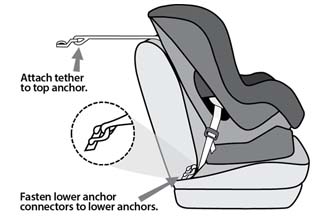 Machine prophylactic seats may exist installed with either the vehicle's seat chugalug or its LATCH (lower anchors and tethers for children) system. LATCH is an zipper organisation for car rubber seats. Lower anchors can be used instead of the seat belt to install the seat, and many parents find them easier to use in some cars. The top tether should always be used with a forward-facing seat, whether y'all employ the seat belt or lower anchors to secure it. The seat chugalug and LATCH systems are equally safe, and then caregivers should use 1 or the other, whichever works all-time for them, for their car safety seat, and their vehicle. In general, caregivers should simply use 1 of the two options unless the car prophylactic seat and vehicle manufacturers say it is OK to use 2 systems at the same time.
Vehicles with the LATCH organisation accept lower anchors located in the back seat, where the seat cushions meet. Tether anchors are located behind the seat, either on the panel behind the seat (in sedans) or on the back of the seat, ceiling, or flooring (in most minivans, SUVs, hatchbacks, and pickup trucks). All forward-facing automobile safety seats have tethers or tether connectors that fasten to these anchors. Virtually all passenger vehicles and all car safety seats made on or after September 1, 2002, are equipped to utilise LATCH. See vehicle owner's manual for highest weight of child immune to use top tether.
All lower anchors are rated for a maximum weight of 65 pounds (total weight includes car safety seat and kid). Parents should check the car safety seat manufacturer'southward recommendations for maximum weight a child can exist to use lower anchors. New car safe seats take the maximum weight printed on their label.
Notation: Seat belts—If you install a auto safety seat past using your vehicle's seat chugalug, you must make sure the seat belt locks to hold the seat tightly. In virtually newer cars, you can lock the seat belt by pulling it all the fashion out and then allowing it to retract to proceed the seat belt tight around the automobile safe seat. In addition, many car safety seats have congenital-in lock-offs so you can lock the belt without having to lock the seat chugalug separately too. Refer to the vehicle owner's transmission for details about how your seat chugalug locks.
Centre of the dorsum seat—The safest place to ride for all children younger than xiii years is the back seat. If possible, it may be best for the child to ride in the middle of the back seat. However, information technology is sometimes difficult to install a automobile safety seat tightly in the eye if the vehicle seat is narrow or uneven. Also, many vehicles do not have lower anchors for the middle seating position. It is safest to put the machine condom seat in a position where you can install it tightly with either the lower ballast arrangement or the seat belt; in some cases, this position may exist on either side of the dorsum seat rather than in the middle. A child passenger rubber technician (CPST or CPS technician) can aid you decide which place is best to install your child's auto safety seat in your vehicle.
Infants & toddlers—rear-facing seats
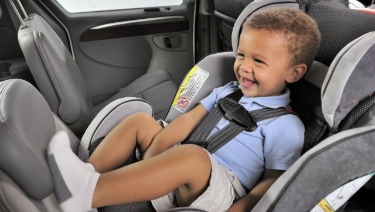 The AAP recommends that all infants ride rear facing starting with their offset ride home from the hospital. All infants and toddlers should ride in a rear-facing seat as long every bit possible until they reach the highest weight or tiptop allowed by their car rubber seat manufacturer. Most convertible seats have limits that will allow children to ride rear facing for 2 years or more. When infants outgrow their rear-facing–but seat, a convertible seat installed rear facing is needed. All parents can do good from getting installation assistance from a CPST to ensure that their child'south seat is properly installed.
Types of rear-facing seats
Three types of rear-facing seats are available: rear-facing–only, convertible, and all-in-1. When children attain the highest weight or length allowed by the manufacturer of their rear-facing–merely seat, they should continue to ride rear facing in a convertible or all-in-one seat.
Rear-facing–only seats
-
Are used for infants upwardly to 22 to 35 pounds and 26 to 35 inches, depending on the model.
-
Are pocket-sized and have carrying handles.
-
Usually come with a base that can be left in the auto. The seat clicks into and out of the base then you don't have to install the seat each time you use it. Parents tin buy more than one base for boosted vehicles.
-
Should be used only for a child's travel (non sleeping, feeding, or whatever other use exterior the vehicle).
Convertible seats (used rear facing)
-
Can be used rear facing and, later, "converted" to forrard facing for older children when they outgrow either the weight limit or the length limit for rear facing. This means the seat can be used longer by your child. Convertible seats are bulkier than baby seats, however, and they practise non come with carrying handles or carve up bases and are designed to stay in the motorcar.
-
Many have higher limits in rear-facing weight (upwardly to xl–50 pounds) and superlative than those of rear-facing– but seats, a feature that makes convertible seats ideal for bigger babies and toddlers.
-
Take a v-point harness that attaches at the shoulders, at the hips, and between the legs.
-
Should be used only for a child's travel (not sleeping, feeding, or whatever other use outside the vehicle).
All-in-one seats (used rear facing)
-
Can exist used rear facing, forward facing, or as a chugalug- positioning booster. This means the seat may be used longer by your child equally your child grows.
-
Are often bigger in size, and then it is of import to cheque that they fit in the vehicle while they are rear facing.
-
Practice non have the convenience of a carrying handle or separate base; all the same, they may have college limits in rear-facing weight (upwards to forty–50 pounds) and pinnacle than those of rear-facing–only seats, a feature that makes all-in-one seats ideal for bigger babies and toddlers.
Installation tips for rear-facing seats
E'er read the vehicle owner's manual and the car safety seat manual before installing the seat.
When using a rear-facing seat, keep the following tips in listen:
-
Identify the harnesses in your rear-facing seat in slots that are at or beneath your child's shoulders.
-
Ensure that the harness is snug (you cannot pinch any slack between your fingers when testing the harness straps over the kid'southward shoulders) and that the chest clip is placed at the center of the chest, even with your kid'due south armpits.
-
Brand certain the car safety seat is installed tightly in the vehicle with either lower anchors or a locked seat belt. Many car rubber seats accept an integrated lock-off organization to continue the seat belt locked. If your seat has one, follow the manufacturer's recommendations on how to use it. If you can move the seat at the belt path more an inch side to side or front to back, it'due south not tight enough.
-
Never place a rear-facing seat in the front seat of a vehicle that has an agile front passenger airbag. If the airbag inflates, it will hitting the back of the car safety seat, right confronting your child's head, and could crusade serious injury or death.
-
If you are using a convertible or all-in-one seat in the rear-facing position, make sure the seat chugalug or lower ballast webbing is routed through the right belt path. Bank check the instructions that came with the motorcar safety seat to be sure.
-
Make sure the seat is at the right angle so your kid's head does non bomb forward. Check the instructions to detect out the right bending for your seat and how to adapt the angle if needed. All rear-facing seats have built-in recline indicators.
-
Check the machine condom seat instructions and vehicle possessor'due south manual most whether the car safety seat may contact the back of the vehicle seat in front end of information technology.
-
All the same having trouble? Check with a certified CPST in your expanse who tin can assist.
Mutual questions
What if my child'south anxiety touch the back of the vehicle seat?
-
This is a very common business organization of parents, but it should cause them no worry. Children are very flexible and can ever easily discover a comfy position in a rear-facing seat. Injuries to the legs are very rare for children facing the rear.
What do I do if my child slouches down or to the side in the car seat?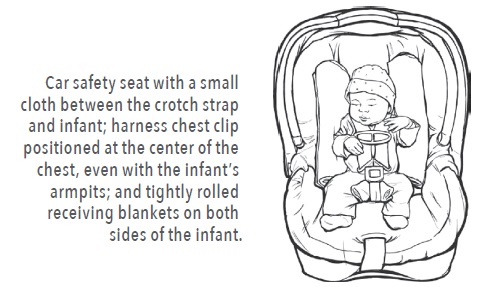
-
You can try placing a tightly rolled receiving blanket on both sides of your child. Many manufacturers permit the use of a tightly rolled small diaper or cloth between the crotch strap and your child, if necessary, to prevent slouching. Practice non place padding under or behind your kid or utilise any sort of auto safety seat insert unless it came with the seat or was fabricated by the manufacturer for use with that specific seat.
Why should I apparel my child in thinner layers of clothing before strapping them into a car safety seat?
-
Bulky clothing, including wintertime coats and snowsuits, can compress in a crash and leave the straps besides loose to restrain your child, leading to increased risk of injury. Ideally, apparel your babe in thinner layers and wrap a glaze or blanket around your baby over the buckled harness straps if needed. See Winter Car Seat Safety Tips from the AAP.
Practice preemies need a special car seat?
A motorcar condom seat should exist approved for a baby's weight. Very small babies who tin can sit down safely in a semi-reclined position unremarkably fit better in rear-facing–merely seats. Babies built-in preterm should be screened while still in the infirmary to make sure they can sit safely in a semi-reclined position. Babies who need to lie apartment during travel may exist able to ride in a car bed that meets Federal Motor Vehicle Safety Standard 213. They should be screened again while in the infirmary to make sure they tin can lie safely in the machine bed.
Toddlers & preschoolers—forward-facing seats
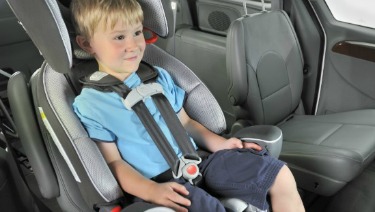 Always read the vehicle possessor's manual and the car safety seat manual before installing the seat.
Whatsoever child who has outgrown the rear-facing weight or meridian limit for her convertible seat should use a forward- facing seat with a harness for as long equally possible, upward to the highest weight or height allowed past her car safety seat manufacturer. It is best for children to ride in a seat with a harness as long as possible, at least to four years of age. If your child outgrows a seat before reaching 4 years of historic period, consider using a seat with a harness approved for higher weights and heights.
Types of Forward-Facing Car Seat Restraints
Iv types of car rubber restraints can exist used forrad facing:
-
Convertible seats: Seats can "catechumen" from rear facing to forward facing. These include all-in-one seats.
-
Combination seats with harness: Seats tin can be used forward facing with a harness for children who weigh up to 40 to 65 pounds (depending on the model) or without the harness as a booster (up to 100–120 pounds, depending on the model).
-
Integrated seats: Some vehicles come with congenital-in forward-facing seats. Weight and height limits vary. Exercise not employ a built-in seat until your child has reached the highest weight or acme immune for your rear-facing convertible machine safe seat. Read your vehicle possessor's manual for details nigh how to use these seats.
-
Travel vests: Vests can be worn by children 22 to 168 pounds and can be an option to traditional frontwards- facing seats. They are useful for when a vehicle has lap-only seat belts in the rear, for children with certain special needs, or for children whose weight has exceeded that allowed by car safety seats. These vests usually require employ of a acme tether.
Installation tips for frontwards-facing seats
Always read the vehicle possessor's manual and the automobile safety seat manual before installing the seat.
Information technology is important that the car condom seat is installed tightly in the vehicle and that the harness fits your child snugly.
To switch a convertible or all-in-one seat from rear-facing to forward-facing:
-
Motion the harness shoulder straps to the slots or position that is at or just above your child'south shoulders. Check the instructions that came with the seat to be certain you are positioning the shoulder straps correctly.
-
You may have to adjust the recline angle of the seat and so that it sits more upright in your vehicle. Check the instructions to exist sure.
-
If using a seat belt, make sure it runs through the forrad-facing chugalug path (be sure to follow automobile safety seat instructions) and that the seat belt is locked and tightened. Many car safety seats accept an integrated lock-off to keep the seat belt locked. If your seat has 1, follow the manufacturer'south recommendations on how to use it.
-
If using the lower anchors, make sure that the weight of your kid plus the weight of the seat does not exceed 65 pounds. Nigh seats now state in the transmission and on the stickers on the side the maximum child weight to utilise the anchors. If the child weighs too much, caregivers must use the seat belt to install.
-
Ever use the tether when you can. A tether is a strap that is attached to the top office of a car condom seat and holds the seat tightly past connecting to an anchor point in your vehicle (often on the seat dorsum or rear shelf; see your vehicle owner's manual to find where tether anchors are in your vehicle). Tethers give important extra protection by keeping the car safety seat and your kid's head from moving likewise far forward in a crash or sudden stop. All new cars, minivans, and low-cal trucks are required to take tether anchors as of September 2000. Forward-facing seats come with tether straps. A tether should always be used as long as your child has not reached the top weight limit for the tether ballast. Bank check the motorcar safety seat instructions and vehicle owner'south manual for information near the acme weight limit and locations of tether anchors.
-
Watch the Video: How to Install a Forward-Facing Car Seat
Mutual question
What if I drive more than children than those who can be buckled safely in the back seat?
-
It's best to avert this, especially if your vehicle has airbags in the front seat. All children younger than 13 years should ride in the back seat. If absolutely necessary, a kid in a forward-facing seat with a harness may exist the all-time selection to ride in front. Just be certain the vehicle seat is moved every bit far back away from the dashboard (and airbag) as possible.
Schoolhouse-aged children—booster seats
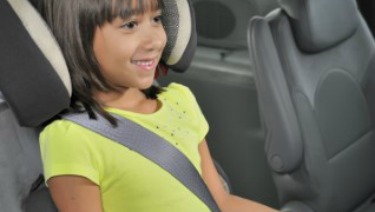 Booster seats are for older children who have outgrown their forrard-facing seats. All children whose weight or top exceeds the forward-facing limit for their automobile safety seat should use a belt-positioning booster seat until the vehicle seat belt fits properly, typically when they have reached 4 feet 9 inches in height and are 8 to 12 years of age. Most children will not fit in well-nigh vehicle seat belts without a booster until 10 to 12 years of historic period. All children younger than 13 years should ride in the back seat. Instructions that come with your motorcar prophylactic seat will tell y'all the acme and weight limits for the seat. As a general guideline, a child has outgrown a frontwards-facing seat when whatever of the following situations is true:
-
They achieve the top weight or peak allowed for his seat with a harness. (These limits are listed on the seat and in the instruction manual.)
-
Their shoulders are above the top harness slots.
-
The tops of their ears take reached the top of the seat.
Types of booster seats
High-back and backless are 2 standard types of booster seats. They do not come with a harness but are used with lap and shoulder seat belts in your vehicle, the aforementioned fashion an developed rides. They are designed to heighten a child upward so that lap and shoulder seat belts fit properly over the strongest parts of the child's body.
Most booster seats are not secured to the vehicle seat with the seat belt or lower anchors and tether but simply residual on the vehicle seat and are held in place in one case the seat belt is attached over a child. However, some models of booster seats can be secured to the vehicle seat and kept in place past using the lower anchors and tether along with lap and shoulder belts. (Currently, only a few vehicle manufacturers offer integrated booster seats.)
Installation tips for booster seats
When using a booster seat, always read the vehicle owner's manual and the car safety seat transmission earlier installing the seat. Booster seats oftentimes have a plastic prune or guide to correctly position vehicle lap and shoulder belts. See the booster seat didactics manual for directions on how to use the clip or guide. Booster seats must be used with lap and shoulder belts. When using a booster seat, make sure:
-
The lap chugalug lies low and snug across your child'southward upper thighs.
-
The shoulder belt crosses the center of your child'due south breast and shoulder and is off the cervix.
-
Watch the video: How to Apply a Booster Seat
If your booster seat has lower anchors or tether attachments, cheque its manual for installation instructions.
Common questions well-nigh booster seats
What if my car has merely lap belts in the back seat?
Lap belts work fine with rear-facing–only, convertible, and forward-facing seats that h av east a harness only tin never exist used with a booster seat. If your auto has just lap belts, utilise a forward-facing seat that has a harness and higher weight limits. You could also
-
Check to see if shoulder belts can exist installed in your vehicle.
-
Use a travel vest (check the manufacturer's instructions about the employ of lap belts only and well-nigh the utilise of lap and shoulder belts).
-
Consider ownership another car with lap and shoulder belts in the dorsum seat.
What is the difference between high-dorsum boosters and backless boosters?
-
Both types of boosters are designed to raise your child then seat belts fit properly, and both volition reduce your child's gamble of injury in a crash. Loftier-back boosters should be used in vehicles without headrests or with low seat backs. Many seats that look similar loftier-dorsum boosters are actually combination seats. They come with harnesses that tin can be used for smaller children and, subsequently, removed for older children. Backless boosters are usually less expensive and are easier to move from one vehicle to another. Backless boosters can be used safely in vehicles with headrests and high seat backs.
Older children—seat belts
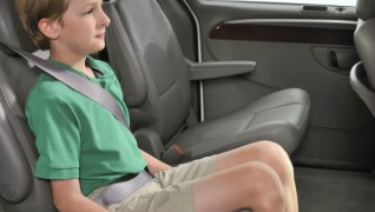
Seat belts are made for adults. Children should stay in a booster seat until developed seat belts fit correctly, typically when children reach nearly 4 feet nine inches in superlative and are 8 to 12 years of age. Nigh children will not fit in a seat belt lone until 10 to 12 years of age. When children are sometime enough and large enough to apply the vehicle seat chugalug alone, they should always employ lap and shoulder seat belts for the best protection. All children younger than xiii years should ride in the dorsum seat.
Using a seat belt:
An developed seat belt fits correctly when:
-
The shoulder belt lies across the middle of the breast and shoulder, non the neck or throat.
-
The lap belt is low and snug across the upper thighs, not the abdomen.
-
Your child is tall enough to sit down against the vehicle seat back with her knees bent over the edge of the seat without slouching and can comfortably stay in this position throughout the trip.
Other points to keep in mind when using seat belts include:
-
Make certain your child does not tuck the shoulder chugalug under her arm or behind her back. This leaves the upper body unprotected and adds actress slack to the seat chugalug system, putting your child at gamble of severe injury in a crash or with sudden braking.
-
Never let anyone to "share" seat belts. All passengers must have their ain car safety seats or seat belts.
Common question
I've seen products that say they can aid brand the seat chugalug fit better. Should we become ane of these?
-
No, these products are unapproved and should not be used. They may actually interfere with proper seat belt fit by causing the lap belt to ride too high on the stomach or making the shoulder belt too loose. They can even damage the seat chugalug. This dominion applies to car safety seats as well; do not use extra products unless they came with the seat or are specifically canonical by the seat manufacturer. These products are not covered by any federal safety standards, and the AAP does not recommend they be used. As long as children are riding in the right restraint for their size, they should not need to use boosted devices.
Shopping for car safety seats
When shopping for a car seat, keep the following tips in mind:
-
No ane seat is the "best" or "safest." The all-time seat is the one that fits your child'southward size, is correctly installed, fits well in your vehicle, and is used properly every time you lot drive.
-
Don't decide by price alone. A higher price does not hateful the seat is safer or easier to use.
-
Avoid used seats if you don't know the seat'south history.
-
Sentry the Video: What to Wait For When Purchasing a Car Seat
Never use a car seat that:
-
Is too old. Await on the label for the date the seat was made. Cheque with the manufacturer to observe out how long it recommends using the seat.
-
Has any visible cracks on it.
-
Does non have a label with the engagement of manufacture and model number. Without these, you cannot cheque to see if the seat has been recalled.
-
Does not come up with instructions. You lot demand them to know how to use the seat. Instructions can be found on manufacturer websites or past contacting the manufacturer.
-
Is missing parts. Used motorcar safe seats often come without important parts. Bank check with the manufacturer to brand sure you tin get the right parts.
-
Was recalled. You tin can detect out by calling the manufacturer or contacting the National Highway Traffic Safe Administration (NHTSA) Vehicle Safety Hotline at 888/327-4236. You tin can besides visit the NHTSA Website.
-
Practise not employ seats that have been in a moderate or severe crash. Seats that were in a minor crash may however be safe to use, merely some car condom seat manufacturers recommend replacing the seat after whatever crash, even a minor one. The NHTSA considers a crash small if all the post-obit situations are truthful:
-
The vehicle could be driven away from the crash.
-
The vehicle door closest to the car safety seat was not damaged.
-
No 1 in the vehicle was injured.
-
The airbags did not go off.
-
Yous can't see any harm to the car prophylactic seat.
-
If you lot have specific questions about the car seat, contact the manufacturer.
Nigh airbags
Front end airbags are installed in all new cars. When used with seat belts, airbags work well to protect teenagers and adults; withal, airbags can be very dangerous to children, particularly to those riding in rear-facing seats and to preschoolers and young school-aged children who are non properly restrained. If your vehicle has a front passenger airbag, infants in rear-facing seats must ride in the back seat. Fifty-fifty in a relatively low-speed crash, the airbag can inflate, strike the motorcar safety seat, and cause serious brain injury and death.
Vehicles with no back seat or a back seat that is not made for passengers are not the best pick for traveling with small children; however, the airbag can be turned off in some of these vehicles if the front seat is needed for a child passenger. Come across your vehicle owner's manual for more than data.
Side airbags are available in most new cars. Side airbags improve condom for adults in side-bear on crashes. Read your vehicle owner'due south manual for more information about the airbags in your vehicle. Read your machine safety seat instructions and the vehicle owner's transmission for guidance on placing the seat adjacent to a side airbag.
About carpooling
If your kid is beingness driven by someone else, make sure:
-
The auto condom seat your child will exist using fits properly in the vehicle used for transport.
-
The machine safety seat being used is appropriate for the age and size of your child.
-
The person in charge of transporting your child knows how to install and use the car safety seat correctly.
Child intendance programs and schools should have written guidelines for transporting children, including
-
All drivers must accept a valid driver's license. In some states, school bus drivers demand to have a special blazon of license.
-
Staff to kid ratios for transport should meet or exceed those required for the classroom.
-
Every child should exist supervised during transport, either past schoolhouse staff or a parent volunteer, so the driver can focus on driving.
-
School staff, teachers, and drivers should know what to do in an emergency, know how to properly use automobile prophylactic seats and seat belts, and be aware of other prophylactic requirements.
Well-nigh car safety seats on airplanes
The Federal Aviation Administration (FAA) and the AAP recommend that children less than forty pounds exist securely fastened in certified kid restraints when flight. This will assist keep them condom during takeoff and landing or in case of turbulence. Most rear-facing, convertible, and forward-facing seats tin can be used on airplanes , but booster seats and travel vests cannot.
Read your seat'south teaching transmission and look for a characterization on the car safety seat that says, "This restraint is certified for use in motor vehicles and aircraft." You can also consider using a restraint made merely for use on airplanes and approved past the FAA. Larger children may apply the aeroplane seat belt or continue to use their car safety seat on the aeroplane every bit long as it is labeled for use on shipping and the child has not exceeded the seat'southward weight or height limit. Remember that your kid will need an appropriate car safety seat to apply at your destination. For more than information, visit the FAA Website or the CARES (Airplane Safety Harness for Children) Website.
If you lot need installation help
If you have questions or need aid with installing your car rubber seat, find a certified kid rider condom technician (CPST or CPS technician). Lists of certified CPSTs and child seat–fitting stations are available on the following websites:
-
National Child Passenger Safe Certification (Click on "Find a Tech" or call 877-366-8154.) – Includes list of CPSTs fluent in Spanish and other languages or with extra preparation in transportation of children with special needs.
-
NHTSA Parents & Caregivers
Important reminders
Be a good part model. Make sure you e'er wear your seat belt. This will help your child course a lifelong habit of buckling up.
Make sure that anybody who transports your kid uses the correct automobile prophylactic seat or seat belt on every trip, every time. Beingness consistent with car condom seat utilize is expert parenting, reduces fussing and complaints, and is safest for your child.
Never exit your child lone in or around cars, and lock your vehicle when it is not in utilize. Any of the following situations tin happen when a child is left alone in or around a vehicle. A child tin
-
Die of heatstroke because temperatures tin can reach mortiferous levels in minutes.
-
Be strangled by power windows, retracting seat belts, sunroofs, or accessories.
-
Knock the vehicle into gear, setting it into motion.
-
Be backed over when the vehicle backs up.
-
Become trapped in the trunk of the vehicle.
Always read and follow the manufacturer's instructions for your auto safety seat. If you do not take those, write or telephone call the visitor's client service department. Staff will ask you for the model number, proper noun of seat, and engagement of manufacture. The manufacturer's accost and phone number are on a characterization on the seat. As well, be sure to follow the instructions in your vehicle owner's manual about using car safety seats. Some manufacturers' instructions may be available on their websites.
Remember to fill up out and mail in the registration card that comes with the car condom seat. You can too register your seat on the manufacturer'due south website. It will be important in case the seat is recalled.
Follow manufacturer directions for cleaning car seats. Cleaning merely not disinfecting is usually permitted. That's because disinfectant products may decrease the protection provided by the seat and harness.
More than information
- Ask the Pediatrician: Is it safe for my baby to travel in a car seat a few hours at a fourth dimension?
- Machine Seats: Product Listing
- Motorcar Seat Checkup
- Auto Seats and Obese Children: Suggestions for Parents
- Forbid Kid Deaths in Hot Cars
- Travel Rubber During COVID-one 9
Although the AAP is not a testing or standard-setting organization, this article sets forth the AAP recommendations based on the peer-reviewed literature bachelor at the fourth dimension of its publication and sets along some of the factors that parents should consider before selecting and using a car seat.
Figure 1 adapted from Usa Department of Transportation, National Highway Traffic Rubber Assistants (NHTSA). LATCH Makes Child Safety Seat Installation as Easy as 1-two-3. Washington, DC: NHTSA; 2011. DOT HS publication 809 489.
Effigy 4 from Bull MJ, Engle WA; American University of Pediatrics Commission on Injury, Violence, and Poison Prevention and Commission on Fetus and Newborn. Rubber transportation of preterm and low nascency weight infants at hospital discharge. Pediatrics . 2009;123(five):1424–1429.
The information independent on this Web site should not be used as a substitute for the medical care and advice of your pediatrician. In that location may be variations in treatment that your pediatrician may recommend based on individual facts and circumstances.
Source: https://www.healthychildren.org/English/safety-prevention/on-the-go/Pages/Car-Safety-Seats-Information-for-Families.aspx
0 Response to "What Age Can Baby Face Forward in Car Seat"
Post a Comment