What Kind of Watering Devices Can Baby Chickens Use
When I was meandering through the aisle of the feed store the other day, I almost grabbed one of those plastic chick waterers. I knew we were going to be needing one soon, since the coop is clean and shiny and the chicks are set to arrive in a couple weeks.
But of course, my craziness innovative, frugal mentality won out, and I decided I would challenge myself to create my own chick waterer from materials I had at home.
After several conversations with my scientifically-minded husband regarding the laws of physics, I scrounged up various plastic containers and began to conduct experiments.
Let's just say I should have payed more attention to our conversations, as I ended some with some flooded counters and sopping wet dish towels.
Anyway. I do believe I have mastered the elusive chick waterer. I am excited to share my findings with you, in hopes of saving you several physics lessons and wet kitchen floors.
Homemade Chick Waterer
First off, here is what I came up with after treasure hunting around my home:
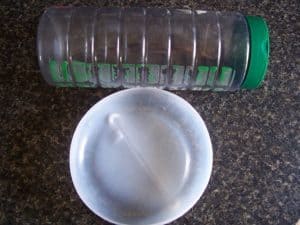
My intial idea was to repurpose this old parmesan cheese container for the top portion. I then cut the bottom off of a plastic gallon jug to make a "dish" that is around 3 inches tall.
However, after some trial runs, I found that the parmesan container didn't work because the lid did not seal securely enough.
So I found a 48 oz lemon juice bottle instead. I highly recommend using a bottle that has a small cap, since it's important that the container holding the water be airtight.
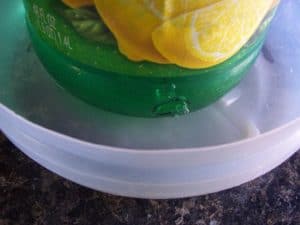
I then poked a small hole, about the diameter of a pencil, near the bottom of the jug.
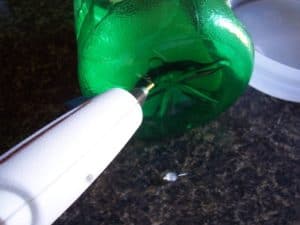
I used a hot glue gun to attach the bottle to the tray. I didn't want to use any sort of glue that might leach into the water and harm the chicks.
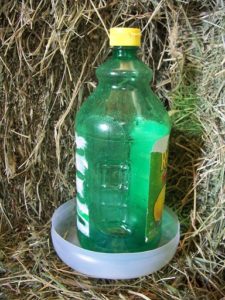
And now you are ready to fill 'er up.The tray should fill until the hole is covered, and then stop. When the chicks drink, the bottle should slowly release water to provide fresh water at all times. A self-refreshing waterer is more ideal than an open pan, since it prevents the chicks from taking a bath or drowning. And we don't want that.
Ready to make your own?
Homemade Chick Waterer Notes
- There are numerous options when it comes to raw materials. Dig through your recycling box, garbage can, or pantry to see what will work. The bottom tray needs to be several inches larger in diameter than your water container. Some ideas could include: milk jugs, yogurt tubs, gallon jugs, large plastic water bottles, etc.
- Make sure to thoroughly wash everything before assembly and don't use any container that might have had substances that would be toxic to the chicks.
- The container that you choose to hold the water must have a lid and be air tight.
- Be mindful of where you place the hole. If it is too high, the tray will overflow. If it is too low, the water level might be unreachable for the chicks.
- If the water does not want to flow, try increasing the size of your hole.
Of course, these same principles could be applied to a larger scale to make a full-sized chicken waterer. If Prairie Baby was older, this would have made a great science experiment. But as of right now, she is more interested in trying to chew on the containers. Oh well, maybe eventually. 😉
Have you ever made a homemade chicken waterer? What materials did you use?

Put Essential Oils to Work Around Your Homestead!
Essential Oils & homesteading go together like peanut butter & jelly. This short, practical eBook will help you master the ins-and-outs of adding essential oils to your homesteading routine (no matter what sort of homestead you may have) and includes DIY fly spray formulas, garden pest control sprays, DIY cleaners, and tons more!
You may also like these posts...
Reader Interactions
Trackbacks
What Kind of Watering Devices Can Baby Chickens Use
Source: https://www.theprairiehomestead.com/2011/03/homemade-chick-waterers.html
0 Response to "What Kind of Watering Devices Can Baby Chickens Use"
Post a Comment